 How to Become a Net Zero Company
 Carbon Offsetting for Businesses Explained
 How Businesses Can Purchase Carbon Removals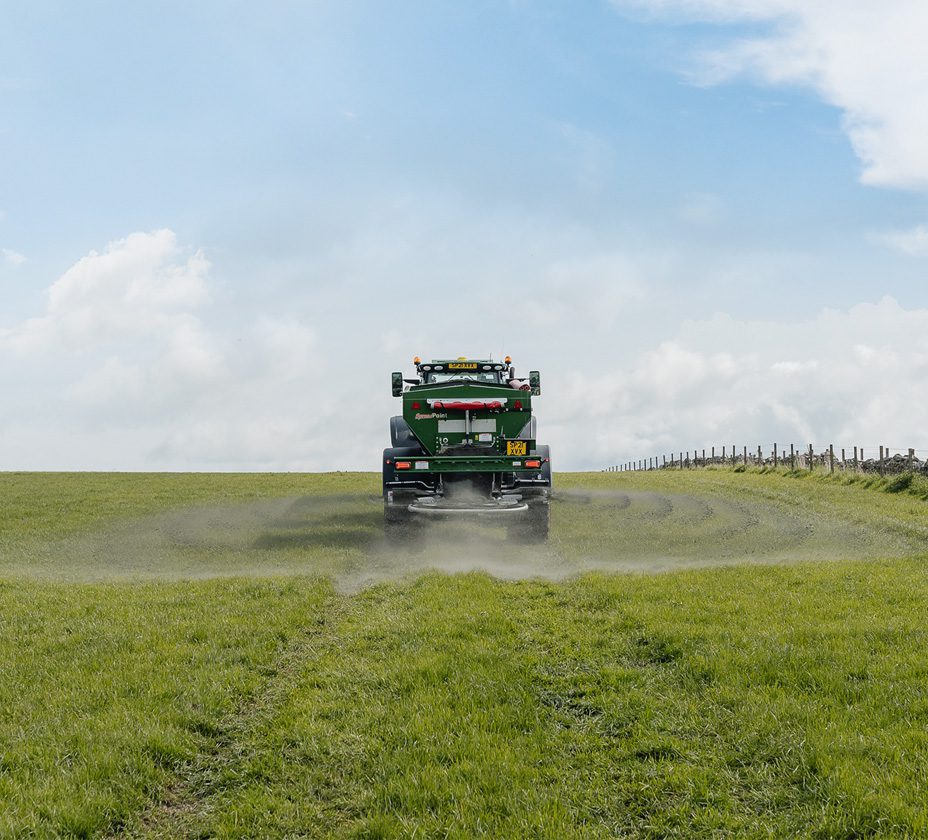
 Speak to our Farming Manager
 The Kingston Wollastonite Rebate 2026
 UNDO Farmers Program in Canada
 How Silicon Boosts Crop Health
 All Resources
 Farmer & Landowner FAQs
 Our Science
 Our Technology
 Our Partners
 Climate Glossary
 Downloads
 Podcasts
 In the Media
 " />
" />
Enhanced rock weathering (ERW) is widely recognised as a promising carbon removal pathway, with measurable benefits for soils and farming communities as well as long-term climate impact.
But one of the biggest barriers to scaling ERW has not been spreading rock itself. It has been the challenge of consistently measuring carbon removal in a way that is robust enough to support verification, commercial confidence, and large-scale deployment. Traditional porewater extraction methods depend on natural soil moisture, which can restrict data collection during dry periods and create gaps in long-term monitoring. As drought conditions become more frequent globally, reliable year-round measurement has become increasingly crucial.
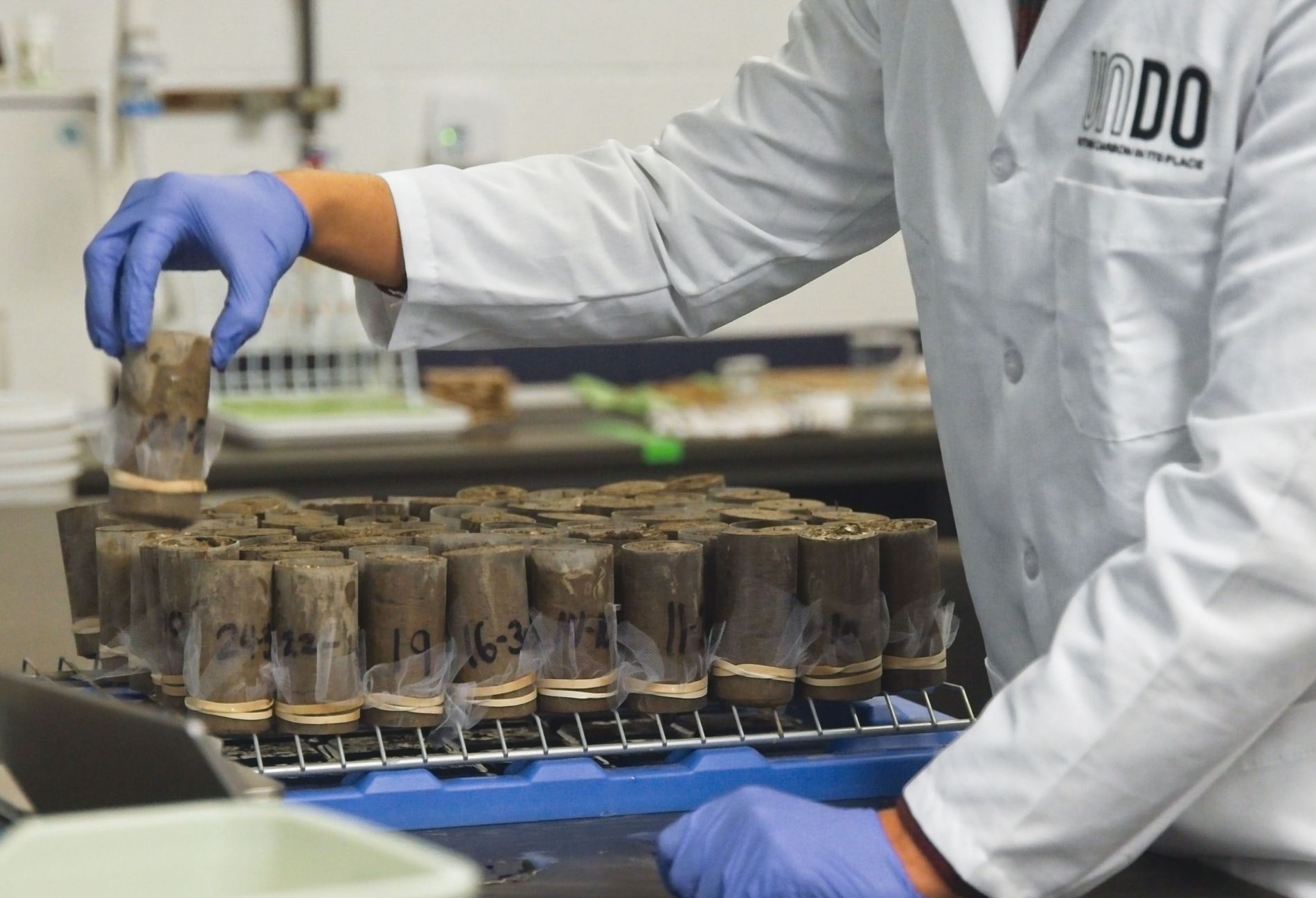
SAT-C was developed to help address this. Short for SATuration-Centrifugation, SAT-C is UNDO’s proprietary, patent-pending technique for extracting soil porewater in enhanced rock weathering projects, designed to support the global scaling of ERW across diverse climates, seasons and soil types. By combining intact soil core collection, controlled saturation using deionised water, and centrifugation, SAT-C is designed to recover porewater for chemical analysis and generate more reliable data under variable field conditions. That work now sits behind a peer-reviewed paper published by Cambridge University Press and co-authored by scientists at UNDO alongside collaborators from Newcastle University, The James Hutton Institute, and independent researchers.
Why Measurement Matters So Much In Enhanced Rock Weathering
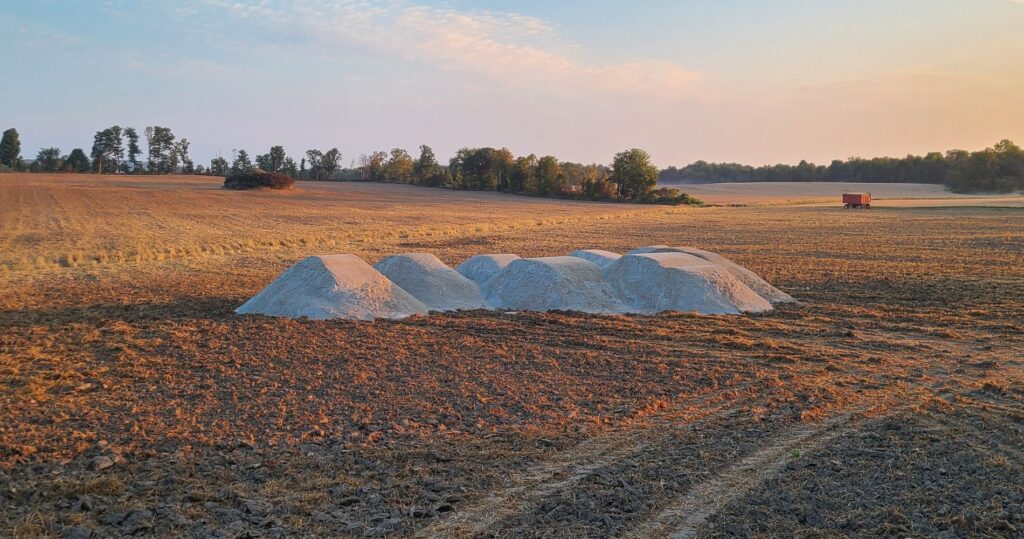
ERW accelerates a natural geochemical process. Crushed mineral-rich silicate rock is spread on farmland, where it reacts with rainwater and atmospheric carbon dioxide over time. That process can improve soil conditions while contributing to permanent carbon removal. But because those reactions occur in open, living systems rather than in highly controlled settings, measuring them accurately can be challenging. Reliable measurement depends on collecting high-quality data across changing weather, seasons, and field conditions.
One of the most important parts of that picture is soil porewater. This is the water held in the spaces between soil particles, and it carries information about what is happening below the surface. In enhanced rock weathering, porewater can contain bicarbonate alkalinity and dissolved cations such as calcium, magnesium, sodium, and potassium, all of which help researchers interpret the progression of weathering. Porewater chemistry can also be used to determine cation fluxes, which act as a proxy for carbon dioxide removal, and to distinguish the strong-acid weathering fraction, which is important for understanding how much of the weathering contributed to CDR.
That is why porewater extraction is such an important part of ERW measurement. When sampling depends too heavily on natural soil moisture, datasets can become fragmented, harder to compare over time, and less useful for carbon accounting.
What SAT-C Is Designed To Do

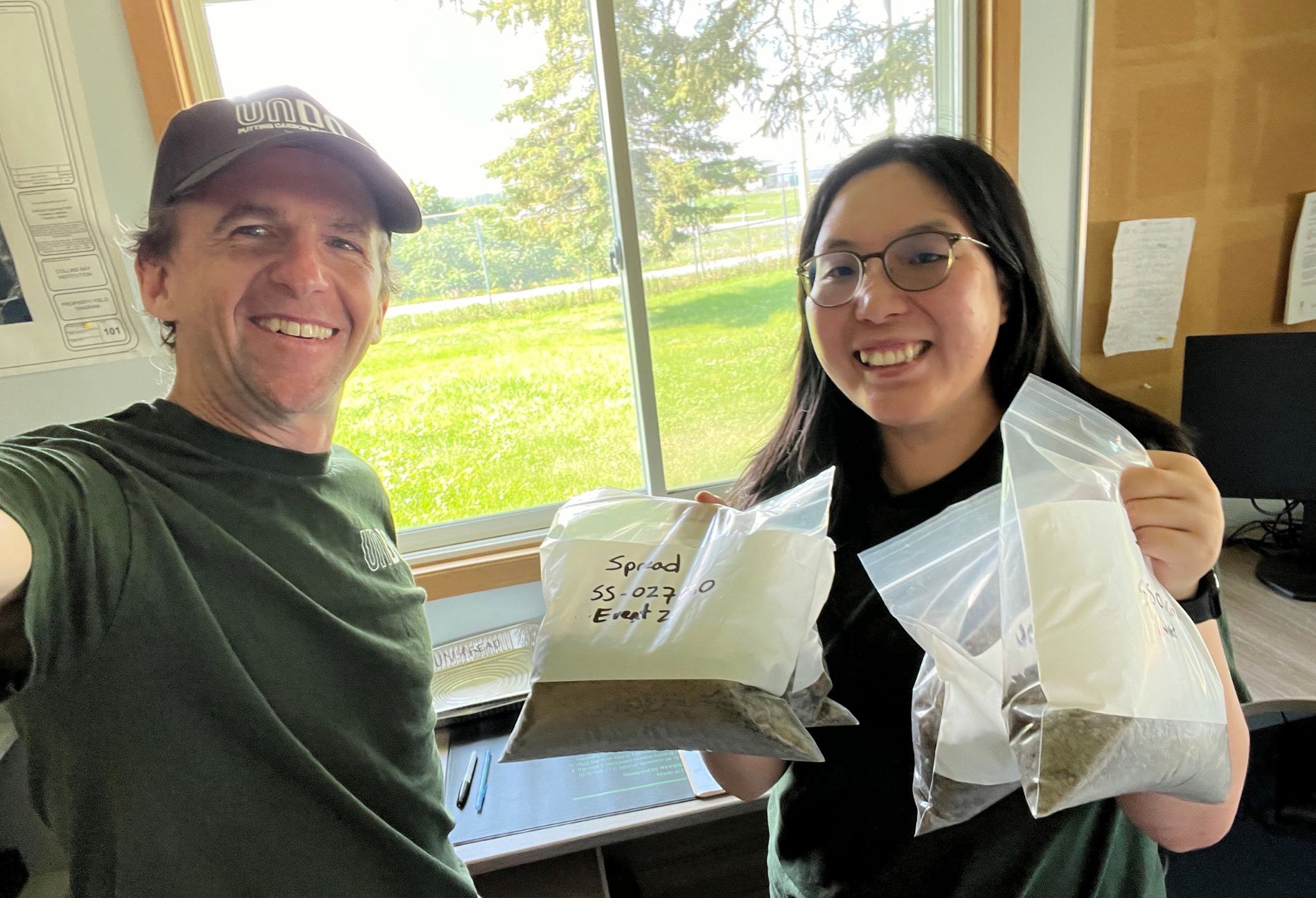
SAT-C is designed to recover porewater from a defined soil volume independently of in-situ moisture conditions. Instead of depending on naturally wet soils to yield a usable sample, the method standardises part of the extraction process. Intact soil cores are collected in the field, saturated under controlled laboratory conditions, and then centrifuged to recover porewater for analysis. In simple terms, SAT-C reduces the extent to which short-term soil moisture conditions determine whether a useful sample can be recovered.
That shift matters because it helps address one of the biggest practical limitations in porewater sampling. By improving reliability regardless of soil moisture levels, SAT-C supports more continuous datasets and makes porewater chemistry easier to interpret over time. Although SAT-C was developed in an ERW context, the challenge it addresses is broader. Seasonal drying, variable soil moisture, and patchy porewater recovery can affect soil monitoring in agriculture, land restoration, and environmental remediation, too, bringing scientific value beyond ERW alone.
SAT-C also makes it possible to generate more than a single chemistry result from one sampling event. Because the method recovers intact soil cores, the same sample can support linked aqueous and solid-phase characterisation, along with bulk density measurements. That matters because using a single sample for multiple types of measurements helps improve dataset quality and internal consistency. Bulk density is especially important when scaling up carbon dioxide removal estimates, and measuring it separately from the main MRV sample can introduce additional noise.
McLaren Racing’s Support For SAT-C
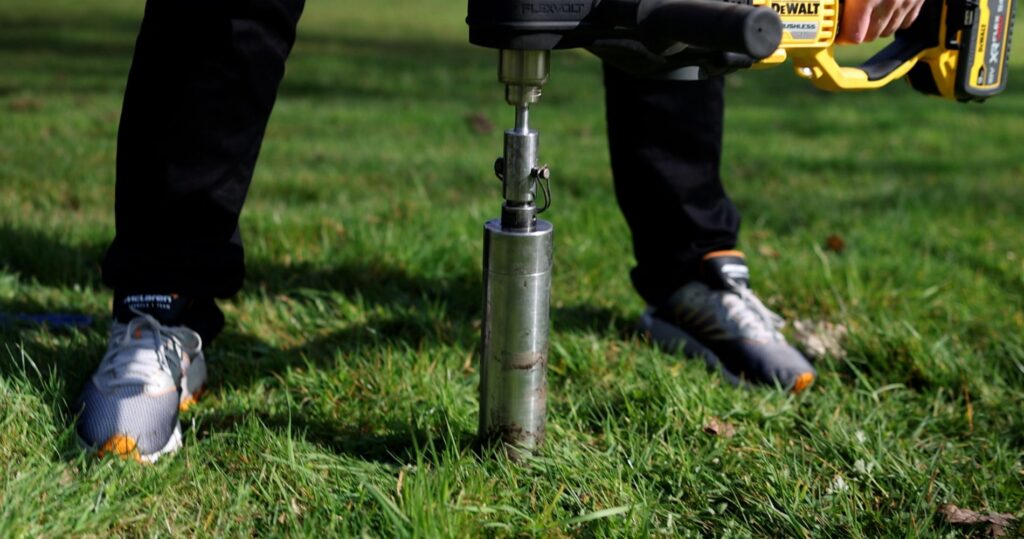
The wider SAT-C programme is also supported by a collaboration with McLaren Racing’s Accelerator programme, whose engineers are helping UNDO prototype next-generation field equipment by applying their racing mindset and high-performance engineering experience. While porewater extraction itself occurs in the lab, the process depends on collecting high-quality, intact soil cores from the field, including in dense, clay-rich soils where consistently reaching 30 cm can be difficult.
To support this, McLaren Racing Accelerator engineers are working with UNDO’s scientists on a prototype SAT-C soil auger designed to make sampling faster, more reliable, and less disruptive. The battery-powered auger uses soil friction to break through dry, compact soils while also operating reliably in wet winter conditions, preserving soil structure and minimising land impact. The latest prototype has reduced soil sampling time by 70% and cut associated emissions by 90%, while improving reliability and ease of use. Work to develop and improve the technology is ongoing.
Kim Wilson, Director of Sustainability at McLaren Racing, said: “At McLaren Racing, we are committed to achieving net zero by 2040 – and playing our part in line with climate science to drive innovation, is an essential part of this. I’m proud that through collaboration with our partners, like UNDO, we can demonstrate the power of sport to inspire meaningful change away from the track. In this case, Accelerator engineers applying high-performance engineering and a racing mindset, to this urgent environmental challenge, to help accelerate climate solutions at pace.”
What The Peer-Reviewed Paper Shows
The peer-reviewed paper evaluates SAT-C against traditional porewater extraction methods, rhizons and lysimeters, across two Scottish ERW field trials, Dumyat and Glensaugh. That makes it a practical comparison between SAT-C and established methods used for soil water extraction in the field.
Crucially, SAT-C porewater chemistry showed strong agreement with rhizon samples for major ions, indicating that both methods were capturing a comparable chemical signal. That matters because it suggests SAT-C is not introducing a new signal or distorting what is already present in the soil. Instead, it is measuring the same underlying chemistry as established methods, but without the same dependence on natural soil moisture. Water yield was sufficient for chemical analysis in 91 of 96 samples collected across all methods. At Glensaugh, several rhizons and one lysimeter did not yield sufficient sample volume, whereas all SAT-C cores did. Overall, the paper concludes that SAT-C provides a robust and reproducible approach to soil porewater extraction, with the potential to improve sampling reliability under variable conditions and support more reliable carbon accounting in ERW.
The study also found that the 24-hour SAT-C protocol was more reproducible than the 72-hour version under the conditions tested. That kind of refinement matters because the value of SAT-C depends not just on recovering water but on recovering data that is dependable enough to support interpretation.
Why Collaboration Matters To The SAT-C Story

SAT-C was developed to solve a practical measurement challenge, but it was not developed in isolation. The paper reflects that, with co-authors from UNDO, Newcastle University, The James Hutton Institute, and independent researchers. That matters because reliable enhanced rock weathering measurement depends on expertise across field science, soil chemistry, geochemistry, and carbon accounting, not just one part of the system.
This collaborative approach gives SAT-C a stronger footing within the growing scientific toolkit for measuring enhanced rock weathering. It helps ground the method in the broader scientific work required to measure ERW effectively, and reinforces that SAT-C has been developed, tested, and peer-reviewed in collaboration with external scientific partners.
Since the initial study, validation work for SAT-C has also been expanded at scale in UNDO’s Canadian field trials. These results support the initial experiments and are due to be presented at Goldschmidt in Montréal in July 2026. That ongoing work is important because it shows SAT-C not only as a published method, but as an active and evolving part of a wider scientific programme.
A Stronger Foundation For ERW Measurement
The significance of SAT-C extends beyond a single comparison between methods. It points toward a more mature approach to measuring enhanced rock weathering, one where data collection is less constrained by short-term soil moisture conditions, measurements are easier to compare over time, and the evidence base becomes stronger as the field develops. Because SAT-C is designed to reduce dependence on in-situ soil moisture, it also has the potential to support more comprehensive datasets in regions where porewater collection has historically been seasonal. Better measurement strengthens carbon accounting, improves carbon credit quality, and supports underwriting confidence, all of which are essential if enhanced rock weathering is to scale credibly.
For UNDO, SAT-C sits at the heart of a broader effort to build the measurement infrastructure that enhanced rock weathering needs. It is proprietary, patent-pending, peer-reviewed, and developed in collaboration with external scientific partners. It is also supported by field-based validation, ongoing Canadian trials, and engineering work to improve the method’s collection process.
As Jim Mann, Founder and CEO of UNDO, said: “Without tackling the measurement bottleneck, enhanced rock weathering will not become the climate tool our planet needs it to be. SAT-C is the critical unlock that will make enhanced rock weathering more credible, auditable and financially viable over time. By combining world-class research with McLaren Racing’s engineering expertise, we are removing one of the biggest barriers to scaling permanent carbon removal globally.”
SAT-C is a meaningful contribution to that effort, helping move ERW measurement onto a more practical and dependable footing under real-world conditions.

Interested In The Science Behind SAT-C?
If you’d like to learn more about SAT-C, ERW measurement, or UNDO’s wider research, we’d love to hear from you.