 How to Become a Net Zero Company

 Our Technology
 Climate Glossary
 " />
" />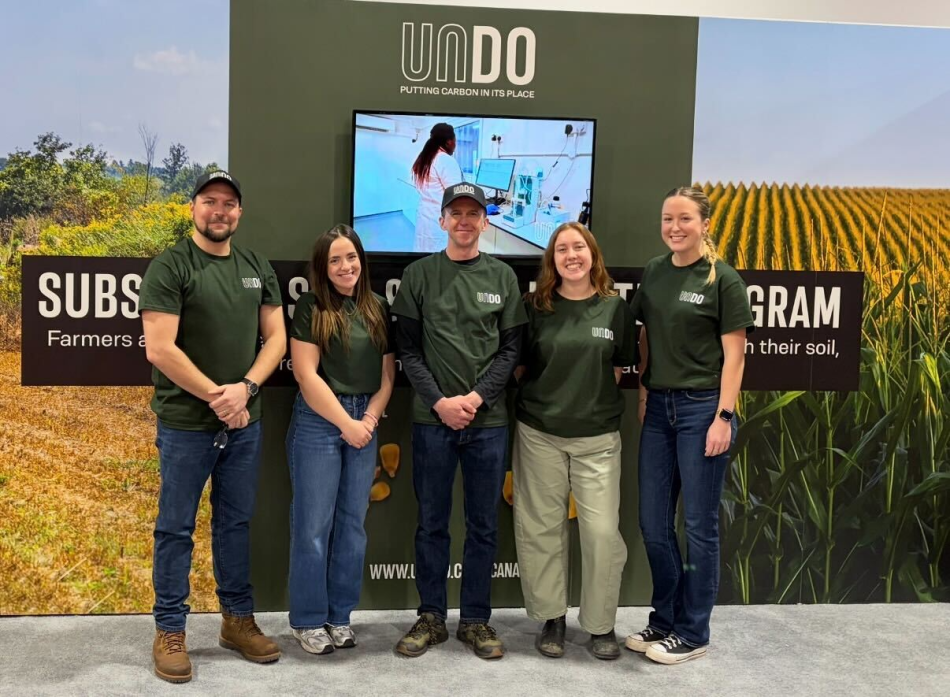
The energy at the Ottawa Valley Farm Show this year was a clear reminder of why Eastern Ontario is such a vital hub for agricultural innovation. Walking the floor and speaking with farmers and landowners from across the region, it was evident that the appetite for natural, science-backed soil solutions is higher than ever.
At UNDO, our time at the show wasn’t just about showcasing our farming program; it was about listening. We spoke with farmers who collectively manage over 20,000 acres, discussing everything from kernel development in corn to the logistical realities of spring spreading. We walked away with a much deeper understanding of the questions that matter most to you.
To keep the momentum going from the show, we wanted to take the time to answer those frequently asked questions.
Why aren’t the big fertilizer companies doing this yet?

The fertilizer industry is highly specialized and excels at delivering immediate, soluble nutrients like nitrogen, phosphorus, and potassium (NPK) that crops need for a single growing season. These companies provide the essential inputs that drive today’s high-yield environments.
Enhanced rock weathering (ERW) operates on a different timeframe. Unlike the standard annual application of synthetic fertilizers, our primary input, wollastonite-rich crushed rock, is a more gradually releasing mineral that takes longer to weather completely. Because this is a nature-based process rather than an industrial manufacturing one, it requires a different operational model.
We aren’t looking to replace your current nutrient program. Instead, we provide a foundational soil amendment designed to support the efficiency of those inputs over multiple seasons. Our local, partner-led model allows us to focus specifically on bridging the gap between climate science and practical soil health. By working with our local mineral partner in Seeley’s Bay and contract applicators right here in Eastern Ontario, we can focus entirely on this long-term mineral release that complements your annual fertilizer strategy.
How does this differ from what other companies offer?
The most common comparison we hear is to agricultural lime. While both can provide pH support, our crushed rock is fundamentally different because it is a long-term, low or zero-cost investment in crop performance and resilience. While lime is primarily used for rapid acidity correction, wollastonite is a gradually weathering calcium silicate that can support your land over multiple growing seasons.
Our program focuses on delivering essential minerals from wollastonite-rich rock, most notably calcium and plant-available silicon. Calcium can help support soil buffering and plays an important role in overall crop and soil health. Wollastonite also provides plant-available silicon, sometimes referred to as a resilience nutrient because it is taken up by the roots and deposited into plant tissues. This can help support stronger plant structure and may contribute to improved tolerance to stresses such as disease pressure. Research has shown that silicon can help reduce the severity of some fungal diseases, including powdery mildew and Fusarium, under certain conditions.
For Ontario farmers, these structural benefits can translate directly to better standability and protection against the elements. Silicon can also play a vital role in water-use efficiency. It can help plants retain moisture and maintain metabolic functions during high-heat periods, a critical factor for the 65% of local farmers concerned about drought risk affecting their yields. While traditional amendments focus on chemistry, wollastonite-rich crushed rock can support the long-term biology and strength of your crop.
What restrictions are there once the rock is applied?
One of the biggest concerns we hear is whether participating in the program will disrupt their existing plans. Our program is designed to sit comfortably alongside your everyday farm operations. There is no need to change your cropping plans, your fertilizer programs, or your choice of equipment. You maintain full control over your land.
Because wollastonite is a natural mineral, it is compatible with a wide range of farming systems. Our rock is approved by the Canadian Food Inspection Agency (CFIA) for use as a fertilizer and is monitored to ensure it exceeds safety standards. We also work to ensure our amendments meet the standards for certified organic farming systems. The main requirement is simply to allow the initial application to take place within the agreed field area. At the moment, there is no standard requirement for future field access on operational spreads. In some cases, we may ask whether follow-up access is possible, but this is not a routine part of participation. We will, however, try to keep participants updated with periodic communications about the wider program and how it is progressing.
Does the rock have to be incorporated right away?
This is a vital logistical question for many farmers moving toward reduced-tillage or no-till systems. The good news is that immediate incorporation is not required.
Enhanced rock weathering begins when the crushed rock reacts with CO₂ dissolved in rainwater. While tillage can help mix the minerals into the root zone, rainfall will naturally wash much of the material into the soil over time, and after a few rains, there is often very little visible on the surface. We have successful operations on a variety of land types, from conventional till systems to permanent pasture and no-till grains.
We work around your agricultural calendar and your specific tillage preferences. Whether you are applying in the fall after harvest or in the spring pre-plant, the goal is to get the material on the ground so the natural weathering process can start. Our team coordinates with local haulage and spreading networks to ensure the application happens during the optimal windows for your fields, using standard spreading equipment.
How Carbon Credits Actually Work in our Program?
We are often asked about the role of carbon credits in our program. It is helpful to view carbon credits as the financial engine that funds the agronomic benefits we are able to bring to farms through our program.
UNDO’s model is built on high-permanence carbon removal through ERW. When mineral-rich silicate rock like wollastonite is spread on farmland, it initiates a natural chemical reaction that captures atmospheric CO₂ and locks it away permanently.
To ensure this process meets the rigorous verification standards required by the global carbon removal market, our team manages the scientific and administrative side of the project, which requires specialised equipment, technical expertise, and long-term data collection. This includes establishing scientific monitoring sites, carrying out soil and water sampling, and completing the laboratory analysis needed to quantify carbon removal over time.
These carbon credits are not generated immediately. They are issued over time as the wollastonite breaks down, and carbon removal can be measured and verified. The sale of those credits is what helps fund the program, covering the cost of the wollastonite and the spreading services provided by local contract applicators. This structure is designed so you can focus on growing healthy, resilient crops while we handle the heavy lifting of verification.
While UNDO retains the carbon credits, we always reassure our farmers that we focus on the carbon capture of the rock alone and make no claim to any other carbon capture linked to the land, such as reforestation. Additionally, ERW allows farmers to benefit from carbon removal initiatives without any changes to production.
Interested In Wollastonite This Season?
Our conversations in Ottawa were a valuable reminder that farmers want practical information they can trust, and a clear understanding of what participation could look like on their own land. That is exactly how we want to approach this work in Eastern Ontario, with transparency, agronomic relevance, and ongoing support from our team.
If you were at the show and did not get a chance to stop by, or if you are a farmer in the region looking to learn more about how wollastonite-rich rock could fit your operation this season, we would love to keep the conversation going. Our team is ready to answer your questions, check your farm’s eligibility, and help you understand how the UNDO program could support your plans for the season, including the Kingston Rebate if your farm is located within the City of Kingston.

Have Questions About the UNDO Farmers Program?
Our team is here to help you understand how wollastonite-rich rock could fit within your operations this season. Contact us to learn more about eligibility, application, and support available in your area.
